
Customer clicks “add to cart,” books a hotel, or hires a plumber, they instinctively do one thing: check the reviews. Online reviews have evolved from a “nice-to-have” feature into a non-negotiable pillar of consumer trust. Studies consistently show that nearly 95% of shoppers read online reviews before making a purchase, and a product with a 4-star rating is significantly more likely to be chosen than one with no ratings at all.
Among the plethora of review platforms, Trustpilot stands as a titan. With over 120 million reviews on more than 500,000 domains, it has become the global standard for customer feedback. A high Trustpilot score can skyrocket your conversion rates, improve your SEO rankings, and serve as a powerful badge of honor on your website.
However, the pressure to maintain a perfect score is immense. For new businesses struggling to get their first ten reviews, or established brands facing a sudden influx of negative feedback, the lure of a quick fix is tempting. This brings us to a controversial shortcut: buy reviews on Trustpilot.
This article will explore exactly what it means to purchase reviews, why businesses are tempted to do it, and the severe risks involved. More importantly, we will provide sustainable, ethical alternatives that build a reputation that actually lasts. By the end, you will understand why the short-term gain of fake reviews leads to long-term pain.
Founded in Denmark in 2007, Trustpilot is an open-source review community that allows consumers to share their experiences with businesses worldwide. Unlike Amazon reviews that are tied to verified purchases only, Trustpilot allows anyone to leave a review, provided the business has invited them or the user has a verified profile. This openness is both its greatest strength and its biggest vulnerability.
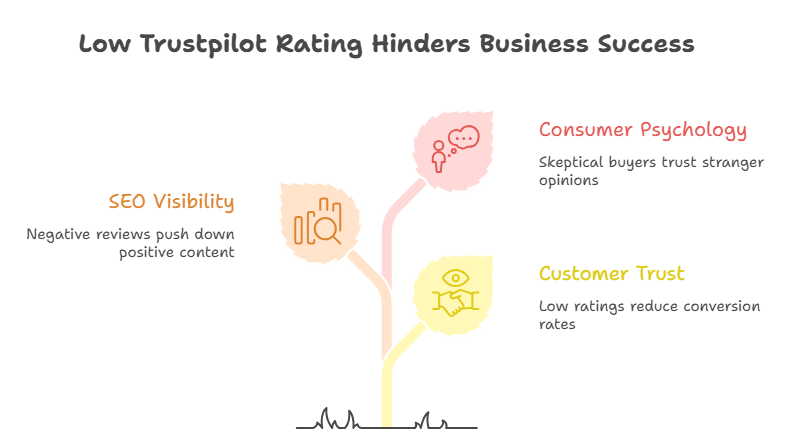
Why does Trustpilot matter so much to modern businesses? The answer lies in three critical areas:
Customer Trust and Social Proof
Trustpilot has become synonymous with legitimacy. When a user sees a Trustpilot widget on a checkout page, it reduces anxiety. According to Trustpilot’s own data, displaying a star rating can increase conversion rates by up to 30%. Consumers are conditioned to look for the green stars; if they don’t see them, or if the rating is low, they bounce.
SEO and Visibility
Google loves Trustpilot. Because Trustpilot has high domain authority, its pages frequently rank on the first page of Google for branded search terms. If you have positive reviews, those pages push down negative news or competitors. If you have negative reviews, they become the first thing a potential customer sees when Googling your brand name.
The Modern Consumer Psychology
The modern buyer is skeptical of marketing jargon but trusts a stranger’s opinion. A survey by Podium found that the average consumer reads ten online reviews before feeling able to trust a local business. For eCommerce, that number is even higher. Without a healthy Trustpilot profile, you are essentially invisible to the risk-averse majority.
For eCommerce stores, SaaS companies, and service providers (like moving companies or repair services), Trustpilot is non-negotiable. It acts as a filter: businesses with a 4.5+ rating get the premium traffic; those below 3.5 struggle to survive.
When we talk about “buying reviews,” we are not referring to ethical incentive programs. Buying reviews refers to the transaction of money in exchange for a customer-written review that is not based on a genuine experience.
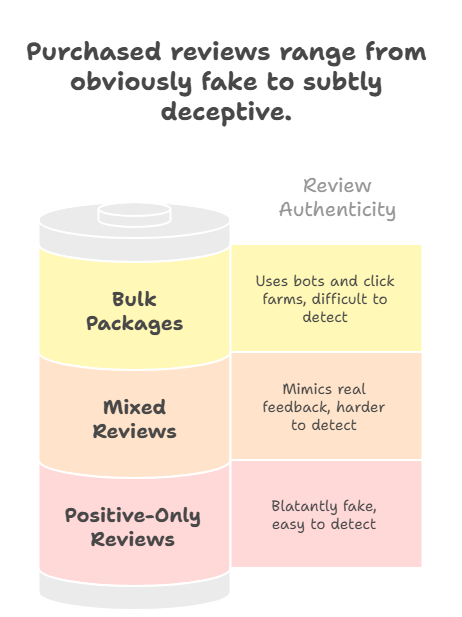
These services, usually found on black-hat SEO forums, social media ads, or freelance marketplaces, offer packages designed to artificially inflate your score. There are generally three types of purchased reviews:
Positive-Only Reviews (The “Perfect 5-Star”)
These are blatantly fake. A user who never bought your product leaves a glowing paragraph about how you “changed their life.” These are the easiest to detect.
Mixed or “Natural-Looking” Reviews
More sophisticated services offer a mix of 4-star and 5-star reviews, occasionally throwing in a 3-star review with a minor complaint (e.g., “Shipping was slow, but customer service fixed it”). The goal is to mimic the statistical distribution of real feedback.
Bulk Review Packages
These are volume-based. Prices vary wildly, but typical models include:
The service provider will usually ask for your Trustpilot URL, a list of keywords you want mentioned (e.g., “fast shipping,” “great support”), and a timeline. They then use VPNs, bots, or click farms to submit the text.
No rational business owner wakes up and thinks, “I love fraud.” They consider buying reviews because they are desperate or under pressure. The reasons are usually rooted in survival instincts.
The “Zero Review” Trap
Imagine launching a brilliant product. You drive traffic via Google Ads. A user clicks your ad, lands on your site, clicks “Reviews,” and sees… nothing. A blank slate. Most consumers assume “no reviews” means “bad product.” To jumpstart the flywheel, business owners buy their first 20 reviews just to look open for business.
Competitive Pressure
If you sell “Blue Widgets” and three competitors have 4.8 stars, but you have 3.2 stars, you lose. Even if your product is superior, the algorithm of perception beats you. In crowded niches (VPNs, hosting, supplements), buying reviews becomes an arms race.
Reputation Management
A business might have suffered a PR disaster or a defective batch. Their rating dropped from 4.5 to 2.5 overnight. Organic recovery takes months. Buying 100 positive reviews can mathematically drag the average back up to 4.0 in a week. It is a band-aid for a bullet wound.
The Psychological Effect of Social Proof
Robert Cialdini’s principle of “Social Proof” states that people copy the actions of others. A business with 1,000 reviews looks safer than one with 10, regardless of the product quality. Buying reviews creates the illusion of popularity, which theoretically leads to actual popularity.
This is the section that could save your business. While the temptation is high, the risks of buying reviews are catastrophic and often irreversible.
Violation of Trustpilot Policies (The Ban Hammer)
Trustpilot’s User Guidelines explicitly prohibit “fake reviews,” “incentivized reviews without disclosure,” and “reviews from people who have not had a genuine experience.” If caught, Trustpilot will not just remove the fake reviews. They will issue a permanent ban. Once banned, you cannot create a new Trustpilot profile. Your domain is blacklisted. You will forever operate without the world’s largest review platform. This is a death sentence for many online businesses.
Sophisticated Fake Review Detection
Trustpilot invests millions in AI and machine learning to detect fraud. They use:
Legal Implications
In the United States, the FTC (Federal Trade Commission) has fined companies hundreds of thousands of dollars for buying or selling fake reviews. In the UK and EU, the Consumer Protection from Unfair Trading Regulations make fake reviews a criminal offense. In 2022, the EU announced a crackdown on “review brigading,” threatening fines of up to 4% of global annual turnover. You aren’t just breaking a website’s rules; you might be breaking the law.
The Exposure Catastrophe
Worse than a ban is public exposure. News outlets love stories about companies caught faking reviews. Imagine the headline: “Local Hero Exposed: XYZ Corp bought 500 fake Trustpilot stars.” Reddit, Twitter, and LinkedIn will roast your brand. The reputational damage of being caught cheating is far worse than having a 3-star rating organically.
Financial Waste and Negative ROI
Most “review selling” services are scams themselves. They often use stolen credit cards to create fake accounts, leading to chargebacks. Even if they deliver, those reviews don’t convert real customers. If a real customer buys based on fake reviews and has a bad experience, they will leave a 1-star review accusing you of fraud. Now you have fake 5-stars and a real 1-star calling you out. You have paid to dig a deeper hole.
Long-term vs. Short-term: Buying reviews offers a 30-day sugar rush followed by a lifetime of paranoia. Every day you worry about detection. Every negative real review feels like a ticking bomb. Organic growth is slow, but it is permanent.
You might think, “I’ll just be smart about it.” Trustpilot is smarter. Their detection system, which they call “Suspicious Review Activity,” operates on multiple layers.
AI and Algorithmic Detection
Trustpilot’s algorithms analyze velocity. If your business averages 2 reviews per week, but suddenly receives 50 reviews on a Tuesday at 3:00 AM, an automatic flag is raised. The system also looks for “reviewer trust scores.” A user who has written 200 reviews for 200 different shoe stores in one day has a low trust score. Their reviews are automatically deprioritized or removed.
Manual Moderation
Trustpilot has a global team of content moderators. They manually review flagged content. They look for generic language like “Great service, highly recommend” without specifics. They also check for “review gisting”—when the same text is copied and pasted across multiple businesses.
User Reporting (The Silent Killer)
Competitors love reporting fake reviews. If you buy reviews, your rival will notice your sudden jump. They will click “Report” on every suspicious review. Trustpilot prioritizes user reports. Once reported, the burden of proof shifts to you. If you cannot provide an invoice or order number for that reviewer, the review is deleted.
Red Flags that Trigger Audits:
Let’s cut through the noise. The honest, data-driven answer is no. There is no truly safe way to buy fake reviews on Trustpilot.
However, you will find “grey hat” SEO agencies arguing otherwise. They claim that by using “aged accounts” and “unique proxies” and “human-written text,” they can evade detection. While this might work for a few weeks or months, it is not a sustainable strategy.
Why “High Quality” Fakes Still Fail:
Trustpilot uses a “user verification” system. If a reviewer does not have a verified purchase link (an email invite from you), their review is marked “Unverified.” Unverified reviews carry less weight in the algorithm and are viewed with skepticism by savvy shoppers. To get “Verified” status, the reviewer must click a unique link from your email server. You cannot buy that unless you hand over your CRM to the fraudster—which is insane.
The “Gray Area” of Incentivized Reviews
Some businesses try to dance on the line by buying products for friends and having them review it. Legally, this is still a “fake review” if the friend didn’t genuinely want the product. Ethically, it is manipulation. Trustpilot allows incentivized reviews only if you clearly disclose the incentive (e.g., “We gave this user a discount for their honest opinion”). Most “buyers” skip the disclosure, making it a violation.
Verdict: If you have to ask if it is safe, it isn’t. The risk-to-reward ratio is negative. You might pay $500 for 100 reviews, but you risk losing $500,000 in future revenue if banned.
Instead of gaming the system, invest your energy into earning reviews. This section is your roadmap to a sustainable 4.5+ rating.
Encouraging Real Customer Feedback
The most obvious alternative is often the most overlooked. Ask. Every customer who has a good experience wants to tell someone. Give them a direct path to Trustpilot.
Email Follow-ups and Automation
Use your CRM (like Klaviyo, HubSpot, or Mailchimp) to automate Trustpilot invitations. Send an email 5 days after delivery. The subject line: “How did we do? [Your Name].” Make the link to Trustpilot one click. Remove friction. According to Trustpilot, automated email invitations generate 70% of all verified reviews.
Ethical Incentivization (Legal and Safe)
You can incentivize reviews, but you must play by the rules. Trustpilot allows you to run a lottery (e.g., “Review us for a chance to win a $100 gift card”). You cannot give a guaranteed discount only for positive reviews. The incentive must be offered to all reviewers (positive and negative) and must be disclosed in the review. This is legal and effective.
Providing Excellent Customer Service
This sounds simplistic, but it is the only real strategy. Over-deliver. Surprise upgrades. Instant support responses. A genuinely happy customer leaves a 5-star review without being asked. Audit your fulfillment process. Where are the friction points? Fix those, and the reviews will follow.
Leveraging Social Proof from Other Platforms
If you have great Google Reviews or Facebook Reviews, embed them on your site while you build Trustpilot. You don’t need Trustpilot on day one. Build a history of customer satisfaction elsewhere, then migrate your power users to Trustpilot via email campaigns.
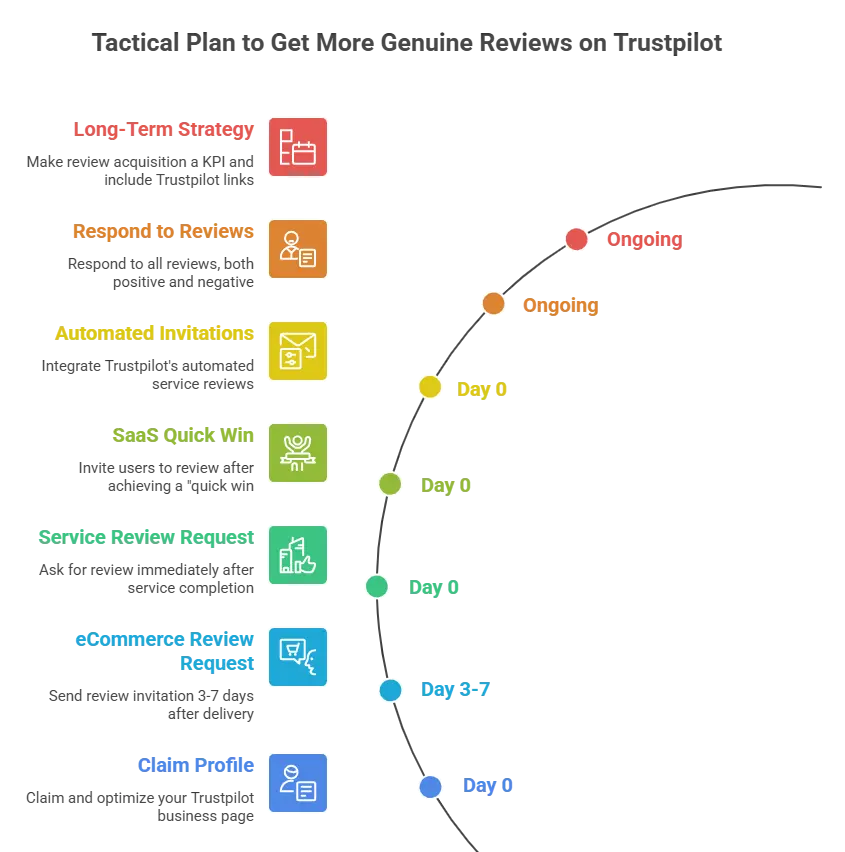
Here is a tactical, actionable plan to grow your Trustpilot profile organically.
Step 1: Claim and Optimize Your Profile
Go to Trustpilot and claim your business page. Fill out everything: logo, description, business hours, website link, and contact info. A complete profile signals to Trustpilot that you are legitimate, which helps your page rank higher in Google search results.
Step 2: Ask at the Right Time
Timing is everything. Ask for a review when the customer is happiest.
Step 3: Use Trustpilot’s Invitation Tools
Trustpilot offers “Automated Service Reviews.” This integrates with your backend (Shopify, Magento, etc.). When an order is marked “Delivered,” Trustpilot automatically sends an invitation. This is the gold standard because it guarantees the “Verified” badge.
Step 4: Respond to All Reviews
Respond to the 5-stars with thanks. Respond to the 1-stars with empathy and a solution. Research shows that businesses that respond to reviews receive 30% more reviews over time. Why? Because customers see you are listening. Even a negative review, when handled well, becomes a marketing asset.
Step 5: Build a Long-term Strategy
Don’t just run a campaign for a month. Make “review acquisition” a KPI for your customer success team. Include a Trustpilot link in your email signatures, your SMS receipts, and your packaging inserts.
Let’s return to the central question. After reviewing the pros (quick jumpstart, competitive parity) and the cons (permanent bans, legal fines, reputational suicide), the answer is clear.
You should not buy Trustpilot reviews.
For every business that claims buying reviews “saved” them, there are a hundred that lost everything. The algorithms are getting better. The regulators are getting angrier. And the consumers are getting smarter.
The only sustainable path to a great Trustpilot score is a great product and a systematic process for asking for feedback. It is slower. It requires hard work. But it builds an asset that appreciates in value over time, rather than a liability waiting to explode.
Invest the money you would have spent on fake reviews into customer experience or email automation. The ROI on truth is infinitely higher than the ROI on deception.
Is it legal to buy Trustpilot reviews?
In most developed countries (USA, UK, EU, Australia), buying fake reviews violates consumer protection laws. The FTC and ASA have issued fines and cease-and-desist orders to companies caught buying reviews. While a single small purchase might not land you in jail, it is a civil violation that can lead to significant financial penalties.
Can fake reviews be detected?
Yes, almost always. Trustpilot uses AI that analyzes review velocity, IP addresses, language patterns, and reviewer history. Manual moderation teams and competitor reporting also catch fakes. Modern detection systems are sophisticated enough to flag subtle anomalies that humans would miss.
How much do purchased Trustpilot reviews cost?
Prices range from $5 to $20 per review from low-quality providers on freelance sites, up to $50+ per review from “premium” services that claim to use aged accounts. Regardless of price, they all carry the same risk of deletion and account suspension.
What happens if you get caught buying reviews on Trustpilot?
First, the fake reviews are removed. Second, your overall TrustScore is recalculated. Third, you receive a warning. Fourth (or immediately for severe cases), Trustpilot places a public “Consumer Alert” on your profile. Finally, your account is permanently suspended, and you are blacklisted from ever opening a new account.
How can I improve my Trustpilot rating organically?
Focus on three things: (1) Automate email invites to verified customers, (2) Fix the operational issues causing your 1-star reviews, and (3) Respond professionally to every negative review to show future customers you care. Over 3–6 months, your score will naturally rise.
Does Trustpilot allow incentivized reviews?
Yes, but with strict rules. You can offer a lottery entry or a discount for any review (positive or negative). You cannot pay for a 5-star review specifically. All incentivized reviews must be clearly labeled as such, or they will be removed as fake.